Security is now an infrastructure question
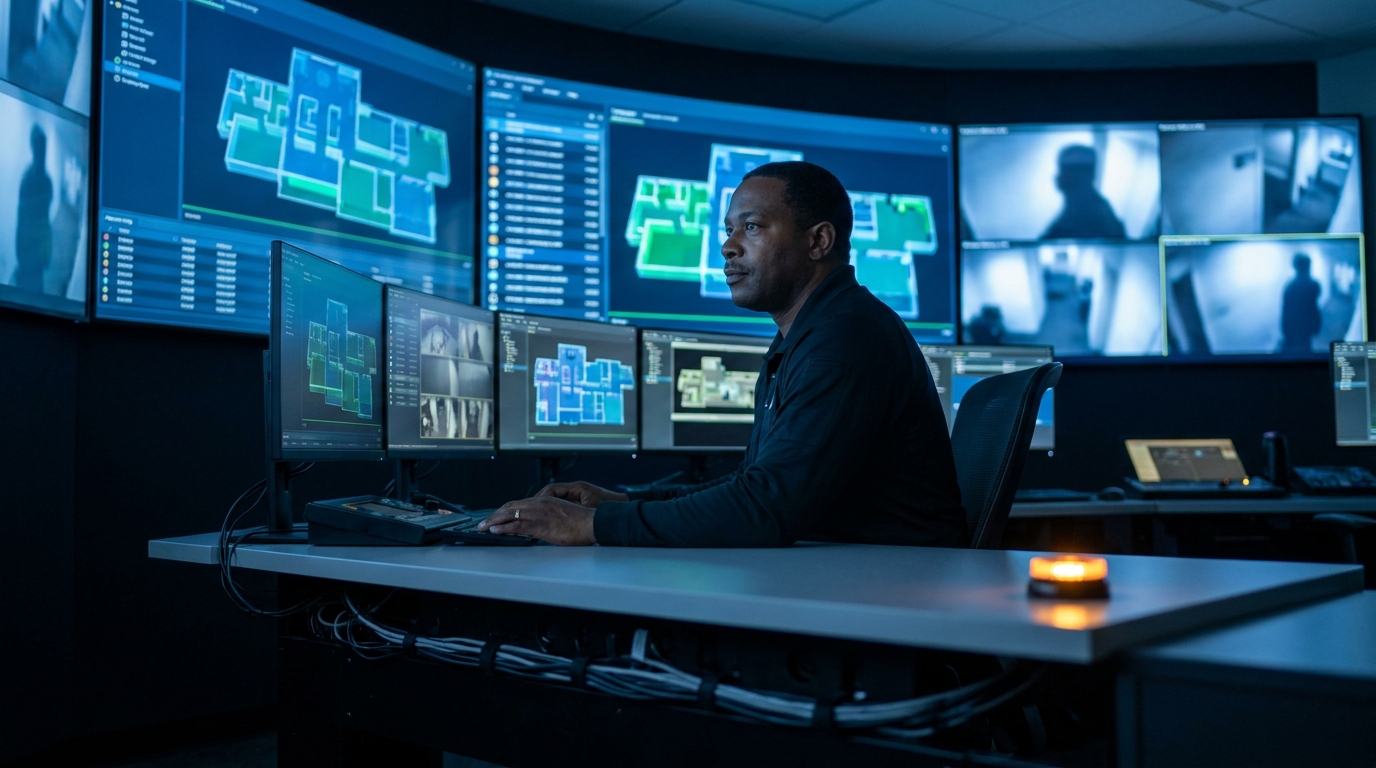
Modern security — access control, CCTV, intrusion and fire detection — increasingly runs on the same networks, power and cooling as the rest of a facility’s critical systems. That convergence brings real benefits: a single pane of glass for the building, correlated events across systems, and lower cost than parallel standalone installations. But it also means security now depends on the same power and network continuity as everything else. A camera system is only as available as the UPS behind it.
Detection and suppression belong in the design, not bolted on
Fire detection and suppression in an equipment room is a specialist discipline, not a retail smoke alarm. Detection has to be sensitive enough to catch an incipient fault early and specific enough not to trip on normal operation; suppression has to protect the equipment without becoming a hazard to it or to people. In a room full of energised electronics, that means designing detection zones, suppression type and interlocks together with the power and cooling — not adding them afterwards.
Building management ties it together
A building management system (BMS) is the layer that turns isolated systems into a coherent, observable whole: power, cooling, access and detection reporting to one place, with alarms, trends and automation. The value is early warning — a cooling unit drifting out of band, a UPS on battery, a door held open — surfaced before it becomes an incident. For a facilities team responsible for uptime, that visibility is the difference between managing the building and reacting to it.
The engineering caution is integration discipline. Every system joined to the BMS is a dependency; each must fail safe, and the BMS itself must not become a single point whose loss blinds the whole building. Good design gives you the visibility without the fragility.
Automation with judgement
Automation — scheduling, set-point control, load shedding, automated responses to alarms — is where a smart building earns its name. But automation should encode good engineering judgement, not replace it. The rules should be conservative, well-tested and always overridable by a human, especially where they touch life-safety or critical load. The goal is a building that quietly does the right thing and tells you clearly when it cannot.
Design it as one system
The through-line is simple: security, detection and building management are no longer separate from power and cooling — they share infrastructure and they share risk. The facilities that get the most from them are the ones that design the whole thing as one system, with continuity engineered in from the start. That is exactly the conversation a site survey opens.